Julia Child’s Coq au Vin
This post may contain affiliate links. Please read our disclosure policy.
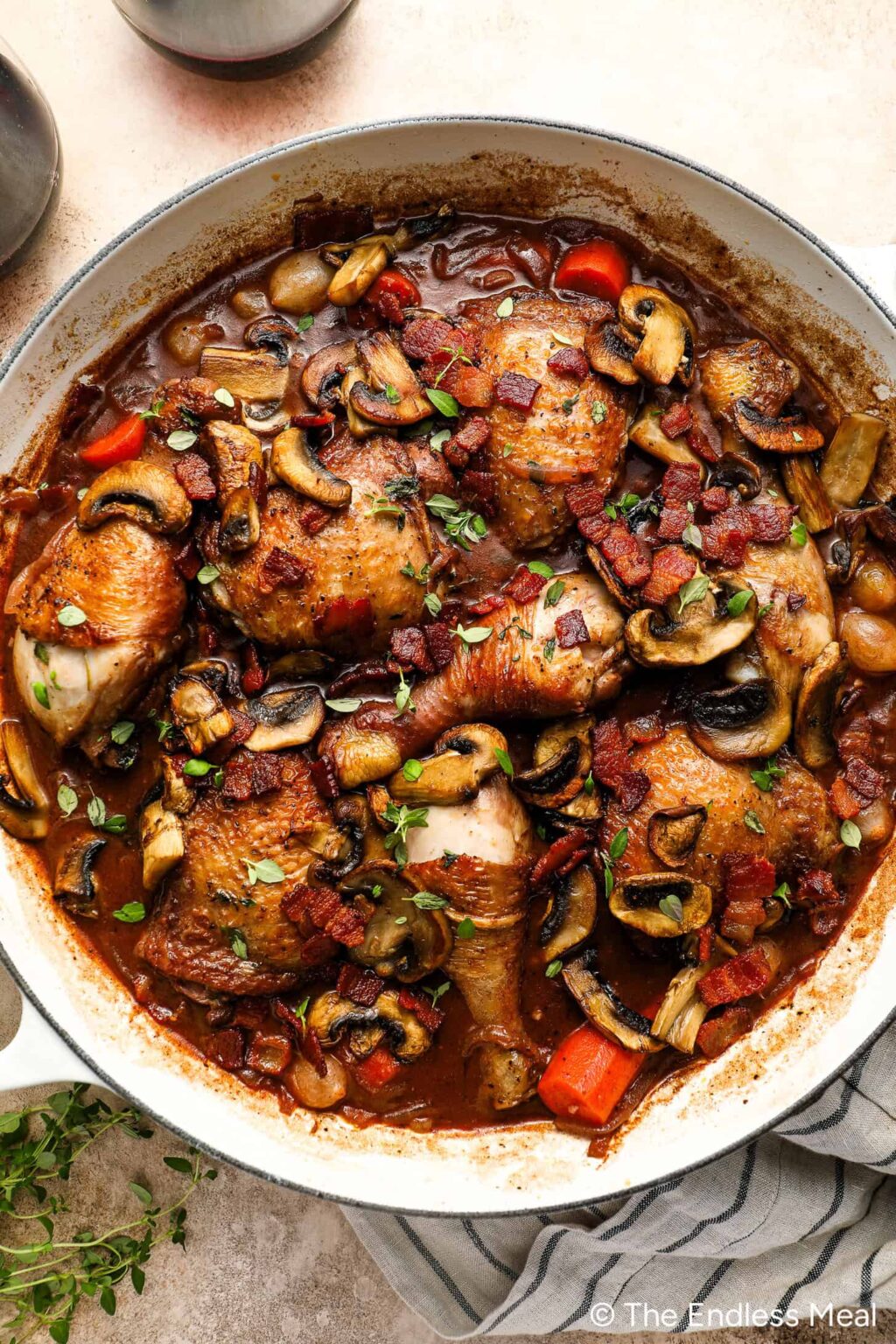
This classic Coq au Vin recipe is undeniably the best. This recipe stays quite true to the original, only minorly modernizing the ingredients and cooking methods. Don’t be intimidated; my recipe is very easy to follow.
One reader, Sue, says, “Loved this recipe! Just made it for the first time and my husband loved it. It was full of flavor. I will definitely make it again! ★★★★★”

Julia Child’s coq au vin (or chicken in wine) is a wonderful but complex recipe that calls for ingredients not common in North American grocery stores. That is why I created a version of her recipe that we can all make and enjoy.
The result is a simple French chicken stew with all the traditional flavors.
What is coq au vin?
Coq au vin translates to ‘rooster in wine.’ A coq au vin recipe is a deeply savory, robust, and hearty French stew consisting of tender chicken braised in red wine with vegetables such as mushrooms, carrots, and onions. Crispy bacon lends more savory depth. It’s warming comfort food that blends savory, sweet, and earthy notes.
Julia Child herself said, “In France, cooking is a serious art form and a national sport.” The French certainly know how to put good food on a plate – it’s one of the most celebrated cuisines in the world!
Coq au Vin Pronunciation
Coq au vin is French for ‘rooster in wine.’ To master the pronunciation, let’s break it down:
- Coq: Pronounced like ‘kohk’ with the ‘o’ similar to the sound of the ‘o’ in ‘coat’
- Au: This is pronounced like ‘oh.’
- Vin: The final word is pronounced as it looks, as ‘vin.’
So all together, you’re saying ‘kohk oh vin.’
This coq au vin recipe
Shortly after starting this blog, I was invited to join a celebration honoring Julia Child’s 100th birthday. Food bloggers united, each tasked with preparing her most famous recipes to share. This was the first time we made coq au vin, but it’s become a staple I’ve made countless times.
It’s more straightforward than the fancy name suggests. It does take a bit of time, but the end result is always totally worth it. I’ve made a few subtle tweaks to the original recipe to reflect modern cooking and diets, providing options for various dietary requirements without venturing too far from Julia Child’s original version.
What makes this coq au vin special?
- Ease: This version of coq au vin is easier to make and uses more familiar ingredients. However, it tastes just as rich and delicious as the original recipe.
- Flavor: Setting the chicken to marinate in the wine while you prep the other ingredients allows the flavor to develop beautifully.
- Chicken: I use chicken thighs and drumsticks in this recipe. The original Julia Child recipe calls for cutting up your own chicken, which is more time-consuming. Using familiar and widely available cuts makes it more approachable without sacrificing flavor.
- Bacon: We sprinkle the cooked bacon on top after the dish is cooked so that it remains crispy. If you leave it in the sauce to cook it does get soggier.
- Tomato: The original recipe calls for a tomato, and we can assume Julia must have meant a summer sun-ripened tomato. Our grocery store tomatoes are sad in comparison, so we use some tomato paste, which has a strong tomato flavor and can be caramelized a little to add some sweetness.
- Carrots: While they are not in the original recipe, carrots make this more of a complete meal.
- Beurre manie: Traditional coq au vin is thickened with butter and flour, which doesn’t work with many modern diets. This version of the recipe gives options for traditional, paleo, gluten-free, and dairy-free beurre manie so you can choose the option that works best for you.
Chicken coq au vin recipe ingredients
French cuisine is very regional, and coq au vin originates in rural farming areas of France, so it calls for wholesome ingredients that comfort and nourish. This hearty, rich, and robust dish calls for these ingredients:
- Chicken: Grab some skin-on, bone-in chicken thighs and drumsticks.
- Beurre manié: If you’re not familiar, this fancy name refers to a combination of flour and butter. See the notes for ratios and dietary-friendly variations.
- Other ingredients: Red wine, chicken broth, bacon strips, onion, carrots, garlic cloves, tomato paste, fresh thyme leaves, mushrooms, and pearl onions.
- Optional: Brandy.
What wine do you use in coq au vin?
Traditionally, coq au vin is made with a Burgundy wine, like a pinot noir. We’ve used lighter reds like Tempranillo and Gamay Noir successfully, and you can also opt for a richer, more robust taste by going for something like a merlot or cabernet sauvignon. The most important thing is that you like the wine you use. The wine adds a lot of flavor to the dish so make sure it’s one you enjoy drinking! We do not recommend using a wine labeled as a cooking wine for coq au vin.
White wine can also be used to make coq au vin blanc. Steer clear of sweet white wines. A Pinot Gris or Sauvignon Blanc works well.
How to Make Coq au Vin
This stovetop recipe is straightforward to follow, albeit a bit time-consuming—it takes 1 hour and 15 minutes. However, the results are totally worth it, and in Julia’s words, “No one is born a great cook; one learns by doing.” So roll up those sleeves and get ready to impress yourself!
- Prep: Pop the chicken in a bowl with the wine, chicken stock, and the brandy if you’re using it. Let it soak up the flavors while you chop the veggies and cook the bacon in a large skillet, pot, or dutch oven on medium-high heat.
- Sear chicken: Remove the chicken from the bowl (save the wine marinade) and sear it until golden. Work in batches, if needed.
- Start coq au vin: Add the onions and carrots first, then the garlic. Next, add the tomato paste until it begins to caramelize, and pour in the reserved red wine marinade. The chicken goes back in with the thyme, then put the lid on to let it simmer.
- Veggies: In another skillet, sauté the cremini mushrooms until they brown. Add the pearl onions to the pan with the chicken.
- Beurre manié: Mix the butter and flour (or another variation). Remove the chicken from the pan, then add the flour mixture. Stir until the sauce thickens, then season with salt and black pepper to taste.
- Finish: Add the chicken and top with the cooked bacon and mushrooms. Garnish with some fresh time, and enjoy!
What to serve with coq au vin
Coq au vin is elegant and impressive enough to serve while entertaining guests, yet homey and comforting enough to serve up when it’s just the family eating at home.
My favorite way to serve this coq au vin recipe is on top of a pile of roasted garlic mashed potatoes with a crisp arugula wild rice salad. The gravy from the coq au vin is incredible poured over the mash, and the salad rounds it out with some added freshness.
Swap the mash out for some steaming basmati rice or cauliflower rice, or crispy roasted potatoes. You could also scoop it over some cooked pasta or egg noodles with some crusty garlic bread for mopping up all the gravy.
For alternate sides, make some braised sturdy greens, like collard, kale, or swiss chard, roasted cauliflower, sauteed green beans, roasted asparagus, or roasted root vegetables. And for dessert, try Julia Child’s Chocolate Mousse. It’s delicious!
Best coq au vin recipe FAQs
If you don’t find the answer you’re looking for here, you can ask it in the comments below, and we’ll get back to you as soon as possible!
How do I make this paleo, gluten-free, or dairy-free?
In the notes section of the recipe, we provide options for making the beurre manie differently for various dietary requirements. For a traditional beurre manie, use 2 tablespoons of all-purpose flour + 2 tablespoons of softened butter. For a paleo and gluten-free beurre manie, use 2 tablespoons tapioca starch + 1 tablespoon softened butter. For a dairy-free beurre manie, use 2 tablespoons flour + 2 tablespoons dairy-free margarine.
How long should I marinate the chicken for coq au vin?
Let the chicken soak up the wine for just the amount of time it takes to prep the veggies and cook the bacon, which is usually around 20 minutes.
How to store leftover coq au vin?
Once your leftover coq au vin has cooled to room temperature, transfer it into an airtight container and put it in the fridge for 3-4 days. You can also pop some in the freezer for up to three months – future you will thank you!
Can you make coq au vin ahead of time?
Absolutely! The flavors actually intensify overnight. Store it in the fridge in an airtight container, then simply reheat it when you’re ready to serve it.
Can I use a dutch oven, slow cooker, or braiser?
In the video, we use a large skillet. But a dutch oven or braiser is perfect for this recipe, so if you have one, this is a good time to use it. If you’re making a slow cooker coq au vin, put it on high heat for 3-4 hours.
Can I make coq au vin with boneless chicken?
You can, however, be aware that boneless chicken cooks much faster, so you’ll need to adjust your cooking time accordingly. One of the reasons we opt for bone-in chicken is for the additional flavor that bone-in chicken provides.


Julia Child Coq Au Vin Recipe
Julia Child’s Coq Au Vin is undeniably the best. This recipe sticks very much to the original, only minorly changing the ingredients and cooking method to bring it in line with the times. While Coq au Vin (or chicken in wine) might sound fancy, it is really just a simple French chicken stew that anyone can master. Don’t be intimidated, this recipe is very easy to follow.
Instructions
Place the chicken thighs and drumsticks in a medium-sized bowl and pour the wine, chicken stock, and (if using) the brandy over the top. Prep the vegetables.
4 chicken thighs, 4 chicken drumsticks, 1 ½ cups red wine, Optional: ¼ cup brandy, 1 cup chicken stock
Add the bacon to a large, high-sided pan or braiser over medium-high heat. Cook until the bacon is crispy, about 8 minutes, then remove it from the pan with a slotted spoon.
3 strips thick-cut bacon or lardons
Remove the chicken from the wine marinade (save the wine) and dry the chicken well with paper towels. Season the chicken with ½ teaspoon of salt and pepper.
Working in 2 batches if needed, place the chicken in the pan, skin side down. Sear until golden on both sides (about 8-10 minutes total), then remove the chicken. Remove all but two tablespoons of the bacon/chicken oil from the pan – reserving the oil to use later in the recipe.
Add the sliced onion and carrots to the pan and let them cook until the onion is golden brown, about 7-8 minutes. Add the garlic to the pan and let it cook for 1 minute.
1 medium onion, 4 medium carrots, 4 cloves garlic
Push the vegetables to the side of the pan and add the tomato paste. Cook the tomato paste until it is fragrant and begins to darken. Pour in the reserved wine marinade, add the remaining ½ teaspoon of salt and pepper, and bring it to a boil for 5 minutes, scraping the bottom to remove any stuck-on bits.
2 tablespoons tomato paste, 1 teaspoon EACH: sea salt and pepper
Nestle the chicken into the pan and sprinkle the thyme over top. Cover the pan, turn the heat to low, and simmer for 20 minutes.
2 teaspoons fresh thyme leaves
Pour 1 tablespoon of the reserved oil (or use olive oil) into a large skillet. Add the mushrooms and saute over medium-high heat until brown, about 10 minutes.
8 ounces mushrooms
Add the pearl onions to the pan with the chicken and cook for 10 minutes.
8 ounces pearl onions
In a small bowl, mix your choice of beurre manie – see notes for the options. Remove the chicken from the pan, add the beurre manie, and stir until the sauce thickens. (You can leave the chicken in the pan if you prefer, but I find it is easier if I remove it.) Season to taste with salt and pepper – I often add an extra teaspoon of each.
Beurre manie
Add the chicken back into the pan and top with the cooked bacon and mushrooms. Sprinkle with a little fresh thyme.
Notes
Wine: Pinot Noir is the traditional option and my personal favorite. Other light-flavored red wines such as Rioja, Tempranillo, or Gamay Noir will also work well. I would avoid bold red wines as you may find they overwhelm the dish. And there’s no need to splurge on an expensive bottle – opt for a low to mid-priced bottle.
Alcohol: Contrary to popular belief, alcohol takes a long time to cook off. Because we are cooking this with the lid on and for a short time, as much as 50% of the alcohol will remain, according to Idaho State University.
Beurre manie options:
- Traditional beurre manie: 2 tablespoons flour + 2 tablespoons softened butter
- Paleo and gluten-free beurre manie: 2 tablespoons tapioca starch + 1 tablespoon softened butter
- Dairy-free beurre manie: 2 tablespoons flour + 2 tablespoons dairy-free margarine
Nutrition
Serving: 1 = ¼ of the recipe, Calories: 635kcal (32%), Carbohydrates: 26g (9%), Protein: 40g (80%), Fat: 34g (52%), Saturated Fat: 10g (63%), Polyunsaturated Fat: 7g, Monounsaturated Fat: 14g, Trans Fat: 1g, Cholesterol: 194mg (65%), Sodium: 487mg (21%), Potassium: 1220mg (35%), Fiber: 5g (21%), Sugar: 10g (11%), Vitamin A: 10509IU (210%), Vitamin C: 14mg (17%), Calcium: 90mg (9%), Iron: 3mg (17%)
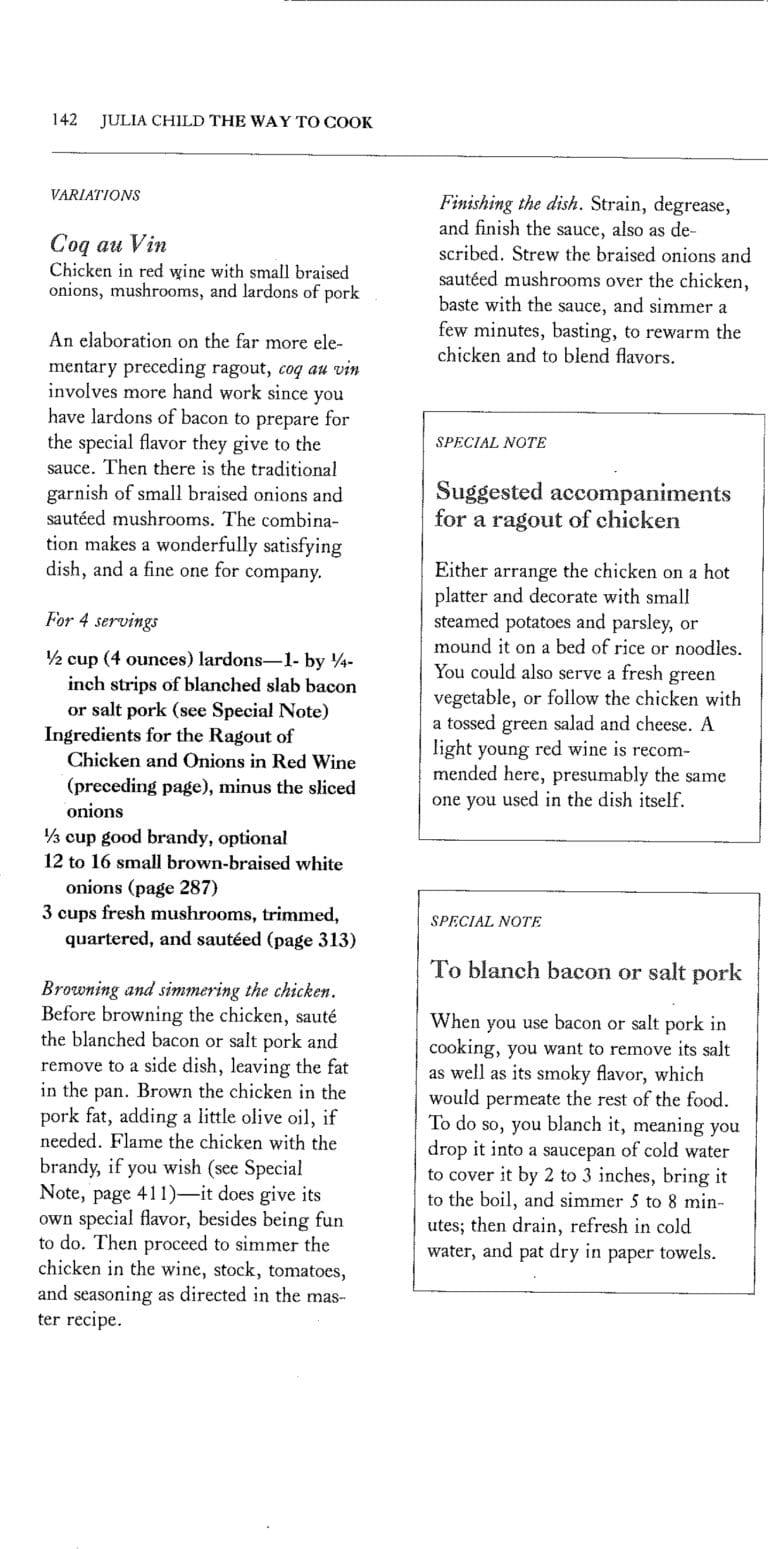
Excerpted from The Way to Cook by Julia Child. Copyright © 1989 by Julia Child. Reprinted with permission from the publisher Alfred A. Knopf, a division of Random House, Inc.